
Good batting is not about talent alone. At club and beginner level, the players who score consistently are usually the ones with the soundest basics, the clearest plans and the calmest heads — not the ones with the flashiest shots. These cricket batting tips cover the foundations that coaches return to again and again, from your stance to your mindset, and they work whether you are facing your first season or your fiftieth. ActiveSG's guide to improving your batting sets out the same fundamentals: a stable side-on stance, feet shoulder-width apart and a relaxed "V" grip.
Cricket batting tips: start with a balanced stance and a relaxed grip
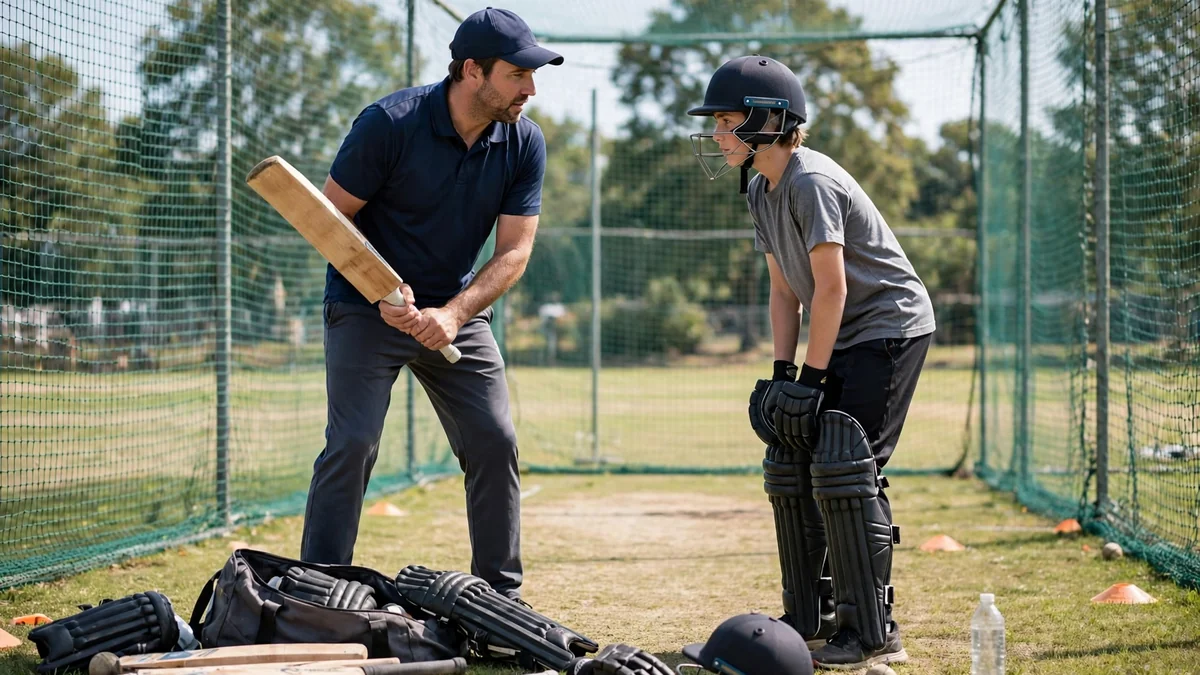
Everything in batting starts before the ball is bowled. Stand side-on, with your feet about shoulder-width apart, knees slightly bent and weight evenly spread — or very slightly forward — so you can move in any direction. Your head should be still and level, with your eyes level too, because a tilted head makes judging line and length much harder.
Hold the bat with both hands close together near the top of the handle, in a relaxed "V" grip, with the back of your top hand facing roughly towards the bowler. Grip it firmly enough that the bat does not twist on contact, but loosely enough that your forearms stay relaxed. A death grip tenses your shoulders, slows your bat speed and makes you drag the bat across the line.
Cricket batting tips: keep a simple backlift and watch the ball
Your backlift — the way you raise the bat as the bowler runs in — should be simple and repeatable. Pick the bat up in a straight line, towards first slip or just outside it, with the face of the bat pointing down towards the ground or slightly towards the wicketkeeper. A backlift that wanders across your body or points the bat face at the sky will make your downswing loop, and you will be late on anything quick.
Watching the ball sounds obvious, yet it is the tip beginners ignore most. Watch the bowler's hand at release, pick up the seam and the line, and then follow the ball all the way onto the bat. Many club dismissals happen because the batter looks up, or across to where they want to hit the ball, a fraction too early.
Get your feet moving: footwork is the foundation of batting
A batter who does not move their feet is a batter who plays everything with their hands, and that is how edges happen. As the bowler delivers, take a small trigger movement — a short step forward or a gentle press onto your toes — so you are already in motion when you judge the length.
The rule is simple: step forward to a full ball and get your head over it, and step back to a short ball and give yourself room. If the ball is on a good length, stay balanced and play it late, under your eyes. In a match, decisive feet turn balls you would have edged into balls you control.
Play the ball late, straight and under your eyes
The straight bat is the safest bat in cricket, especially early in an innings. Play the ball as late as you can, with your head over the ball and your hands close to your body. When you play forward, your front elbow should point towards the bowler and your bat should come down in a straight line, not across your pads.
Resist the urge to hit across the line in your first few overs. The cover drive and the pull shot are wonderful strokes, but they are also the shots that get beginners out. Earn the right to play them: get your eye in, see how the pitch behaves, and only then start expanding.
Shot selection: know which balls to hit and which to leave
Batting is as much about the balls you do not play as the ones you do. Leave anything wide outside off stump that you cannot reach comfortably, especially early on. Let the ball go through to the keeper rather than chasing it and edging behind.
Choose one or two scoring shots you trust — a straight drive, a flick off your pads, a cut — and build your innings around them. When you do decide to attack, commit fully: a half-hearted big shot is far more dangerous than a full-blooded one or a solid defensive stroke.
Playing pace: trust your defence and use the bowler's speed
Against genuine pace, time is short, so simplify everything. Stand a little taller, keep your backlift compact, and play the ball under your eyes rather than reaching for it. A solid forward defensive shot, played with soft hands, is your best friend: soft hands mean the ball drops at your feet instead of carrying to slip.
Do not try to hit fast bowling hard in your first overs. Let the ball come to you, defend the good balls, and score from anything short or wide. Never take your eyes off the ball to admire a shot — against pace, that is when the next ball arrives.
Playing spin: use your feet and read the ball from the hand
Spin bowling tests a different skill: reading the ball before it pitches. Watch the bowler's wrist and fingers at release, because that is where the turn is decided. A leg-spinner's wrist, an off-spinner's fingers and a googly's disguised release all give clues — if you watch for them.
Use your feet to spin. Step down the pitch to a flighted ball and smother the turn, or go right back in your crease to a shorter ball and play it late. What you should not do is stay rooted to the crease, lunging at the ball with your hands. If you are unsure which way the ball will turn, play with a straight bat and defend with your pad close to the bat, so there is no gap for the ball to sneak through.
Run hard between the wickets
Runs are not only made with the bat. Sharp running turns ones into twos, keeps the scoreboard moving when boundaries dry up, and puts pressure on the fielding side. Always back up at the non-striker's end, call loudly and early — "yes", "no" or "wait" — and run your first run hard, because the second run is decided by how fast you take the first.
Practise turning quickly: run with your bat in your outside hand, slide or ground your bat early, and push off hard for the second run. Poor running causes more run-outs at club level than brilliant fielding does, so agree your calls with your partner before you bat together, and never run on a fielder's throw if you are unsure.
Build an innings in stages, not in one rush
The best club innings are built in stages. In the first ten balls, your job is to survive, watch the ball and learn the pitch. In the next twenty, you start to score from the loose balls and rotate the strike. Only after that, when you are set and the bowlers are tired, do you look to dominate.
Set small targets rather than thinking about a big score: ten runs, then twenty, then fifty. Each milestone resets your focus and keeps you in the present. If you get a life — a dropped catch or a missed stumping — treat it as a fresh start and make the opposition pay for it.
Think like a batter: the mental side of batting
Finally, batting is a mental game. Between balls, breathe, look around, and clear your mind. Have a simple routine — tap your bat, check your grip, take your stance — and use it every ball, so pressure does not change your preparation. If you play a bad shot, let it go: the next ball is a new contest, and dwelling on the last one only helps the bowler.
Stay positive but honest. If you are struggling against a particular bowler, take a single and get to the other end rather than forcing a shot. If you are set and the bowling is weak, be ruthless. And remember that even the best players in the world get out cheaply sometimes — what defines them is how they prepare for the next innings. For inspiration, look at how the best cricket players in the world build their innings, and study the great tournament knocks in our guide to the ICC Men's T20 World Cup 2024.
Put these ten ideas together and you have a complete approach to batting: balanced stance, relaxed grip, simple backlift, busy feet, late straight play, smart shot selection, different plans for pace and spin, hard running, patient innings-building and a calm mind. Practised together, week after week at nets, they are the surest route from beginner to reliable club batter.
Sources: activesgcircle.gov.sg, i.imgci.com, engadinedragonscc.org.au.