
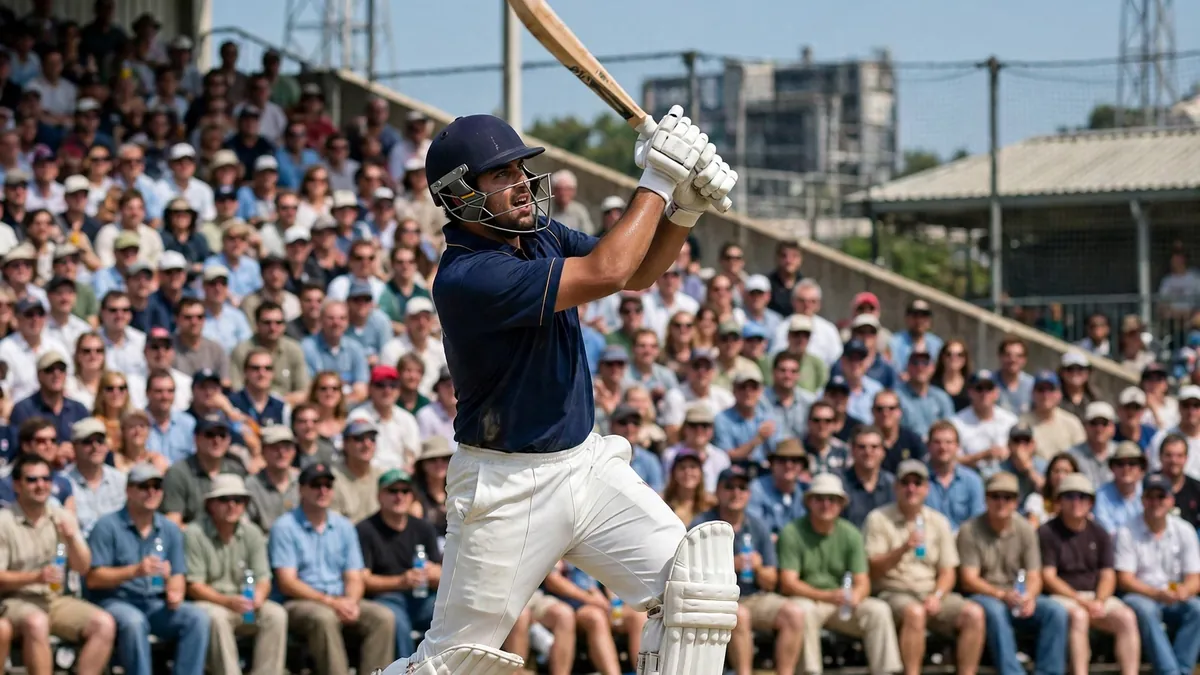
The first six men's T20 World Cups, from 2007 to 2016, did more than crown champions. They set the records every later tournament has been measured against. The T20 World Cup records 2007-2016 era gave us the format's first century, its fastest fifty, its best bowling figures, its highest team total — and its lowest. Some of those marks still stand.
T20 World Cup Records 2007-2016: The Batting Landmarks
Chris Gayle 117 — the first T20 World Cup century
The very first match of the very first T20 World Cup produced its first century. Chris Gayle smashed 117 off 57 balls for West Indies against South Africa at Johannesburg on 11 September 2007. It was also the first century in T20 international cricket. South Africa still won the match, chasing 206 with eight balls to spare, but Gayle had announced what the format could be. He was the only batter with two T20 World Cup centuries until Sahibzada Farhan matched the feat with two hundreds in the single 2026 edition. Gayle's second came as an unbeaten 100 off 47 balls against England in Mumbai in 2016.
Brendon McCullum 123 — the highest score of the era
Brendon McCullum's 123 off 58 balls for New Zealand against Bangladesh in Pallekele in 2012 was the highest individual score in T20 World Cup history at the time, and it stayed the highest of the 2007–2016 era. The other centuries of the era: Mahela Jayawardene scored 100 against Zimbabwe in 2010, Alex Hales made an unbeaten 116 against Sri Lanka in 2014, and Ahmed Shehzad hit an unbeaten 111 against Bangladesh in 2014.
Yuvraj Singh — six sixes and the fastest fifty
No single over in T20 World Cup history is more famous. In Durban on 19 September 2007, Yuvraj Singh hit Stuart Broad for six sixes in one over during India's Super 8 match against England, after an exchange with England captain Andrew Flintoff. He reached his fifty off just 12 balls — still the fastest fifty in international cricket across formats — and finished with 58 off 16 balls as India won by 18 runs. The six-sixes over is the defining image of the first T20 World Cup, and it has never been repeated in the tournament.
Virat Kohli — 319 runs in 2014, 273 in 2016
Virat Kohli's 319 runs in six matches at the 2014 tournament in Bangladesh was the most runs scored in a single edition up to that point, at an average of 106.33. Two years later he scored 273 runs in five matches at an average of 136.50, dismissed only twice. Kohli never scored a T20 World Cup century in this era — his highest score was 89 not out — but his consistency across two tournaments was unmatched. His two campaigns are covered in T20 World Cup Player of the Tournament: Every Winner.
The leading run-scorers of each edition
| Edition | Leading run-scorer | Runs |
|---|---|---|
| 2007 | Matthew Hayden (Australia) | 265 |
| 2009 | Tillakaratne Dilshan (Sri Lanka) | 317 |
| 2010 | Mahela Jayawardene (Sri Lanka) | 302 |
| 2012 | Shane Watson (Australia) | 249 |
| 2014 | Virat Kohli (India) | 319 |
| 2016 | Tamim Iqbal (Bangladesh) | 295 |
Across the whole era, Mahela Jayawardene was the leading run-scorer, with 1,016 runs in 31 matches between 2007 and 2014. Chris Gayle scored 920 runs in 28 matches up to 2016, and Tillakaratne Dilshan scored 897 runs in 35 matches between 2007 and 2016.
T20 World Cup Records 2007-2016: The Bowling Landmarks
Ajantha Mendis 6/8 — the best figures of the era
Ajantha Mendis took 6 for 8 against Zimbabwe at Hambantota on 18 September 2012, in Sri Lanka's opening match of the home tournament. His figures — four overs, two maidens, six wickets for eight runs — were the best in T20 international cricket at the time, and they remain the best bowling figures in T20 World Cup history. Mendis was also the leading wicket-taker of the 2012 tournament, with 15 wickets in six matches. Across the era he took 35 wickets in 21 matches between 2009 and 2014, at an average of 15.02.
Rangana Herath 5/3 and Umar Gul 5/6
The next-best spells of the era were almost as startling. Rangana Herath took 5 for 3 against New Zealand at Chattogram in 2014, defending a small Sri Lankan total. Umar Gul took 5 for 6 against New Zealand at The Oval in 2009, the first five-wicket haul in T20 international cricket, and he remains the only bowler to have led the wicket-taking in two editions, with 13 wickets in both 2007 and 2009. Gul finished the era with 35 wickets in 24 matches.
The leading wicket-taker of each edition
| Edition | Leading wicket-taker | Wickets |
|---|---|---|
| 2007 | Umar Gul (Pakistan) | 13 |
| 2009 | Umar Gul (Pakistan) | 13 |
| 2010 | Dirk Nannes (Australia) | 14 |
| 2012 | Ajantha Mendis (Sri Lanka) | 15 |
| 2014 | Imran Tahir (South Africa) and Ahsan Malik (Netherlands) | 12 each |
| 2016 | Mohammad Nabi (Afghanistan) | 12 |
Most wickets overall in the era
Shahid Afridi finished the 2007–2016 era as the leading wicket-taker in T20 World Cup history, with 39 wickets in 34 matches at an average of 23.25. Lasith Malinga was second with 38 wickets in 31 matches between 2007 and 2014, and Saeed Ajmal took 36 wickets in 23 matches between 2009 and 2014. Samuel Badree, the West Indian leg-spinner central to both of his side's title wins, took 24 wickets in 15 matches between 2012 and 2016 — a reminder that the 2016 champions were built on spin as much as on power-hitting.
A note on Lasith Malinga's four in four
One famous 2007 feat is often misremembered as a T20 World Cup record, so it is worth stating plainly: Lasith Malinga's four wickets in four balls against South Africa came in the 50-over World Cup at Providence, Guyana, on 28 March 2007 — not in the T20 World Cup. Malinga dismissed Shaun Pollock, Andrew Hall, Jacques Kallis and Makhaya Ntini off successive deliveries, becoming the first bowler to take four wickets in four balls in one-day international cricket. It is not a T20 World Cup record, and this article does not count it as one.
Highest and Lowest Team Totals of the Era
Highest team totals
| Total | Team | Opposition | Venue | Year |
|---|---|---|---|---|
| 260/6 | Sri Lanka | Kenya | Johannesburg | 2007 |
| 230/8 | England | South Africa | Mumbai (Wankhede) | 2016 |
| 229/4 | South Africa | England | Mumbai (Wankhede) | 2016 |
| 218/4 | India | England | Durban | 2007 |
| 211/5 | South Africa | Scotland | The Oval | 2009 |
Sri Lanka's 260 for 6 against Kenya in Johannesburg on 14 September 2007 was the highest team total in T20 World Cup history, and it stood at the top of the all-time list for almost two decades. The second and third places on the era list came in the same match: South Africa posted 229 for 4 against England at the Wankhede in Mumbai on 18 March 2016, and England chased it down with two wickets and two balls to spare, finishing on 230 for 8 — the highest successful chase in the tournament's history at the time. Joe Root's 83 off 44 balls was the centrepiece of the chase.
Lowest team totals
| Total | Team | Opposition | Venue | Year |
|---|---|---|---|---|
| 39 | Netherlands | Sri Lanka | Chattogram | 2014 |
| 60 | New Zealand | Sri Lanka | Chattogram | 2014 |
| 70 | Bangladesh | New Zealand | Kolkata | 2016 |
| 73 | Kenya | New Zealand | Durban | 2007 |
| 79 | India | New Zealand | Nagpur | 2016 |
The lowest total of the era — and of T20 World Cup history — was the Netherlands' 39 against Sri Lanka at Chattogram on 24 March 2014. The Dutch were bowled out in 10.3 overs, with Angelo Mathews and Ajantha Mendis taking three wickets each, and only Tom Cooper reached double figures, with 16. Sri Lanka chased the target in five overs. The same tournament produced the second-lowest total too: New Zealand's 60 against Sri Lanka, also at Chattogram, a week later. India's 79 against New Zealand at Nagpur in the opening match of the 2016 tournament remains one of the great shocks of the early years — the hosts, among the favourites, bowled out for 79 on a turning pitch.
Why the Early Years Still Matter
Gayle's 117 showed what an opener could do to a new-ball attack; Yuvraj's over showed that a match could turn in six balls; Mendis's 6 for 8 showed that mystery spin could be the most valuable skill in the format; and the 230-run chase at the Wankhede showed that no total was safe. Later tournaments added bigger scores, but they played on ground the early years had mapped. See also our ICC Men's T20 World Cup 2024 retrospective and the most dangerous teams in the 2022 T20 World Cup.
Sources: sportstar.thehindu.com, newsbytesapp.com, sportsadda.asia, jagranjosh.com, wisden.com, wisden.com.