
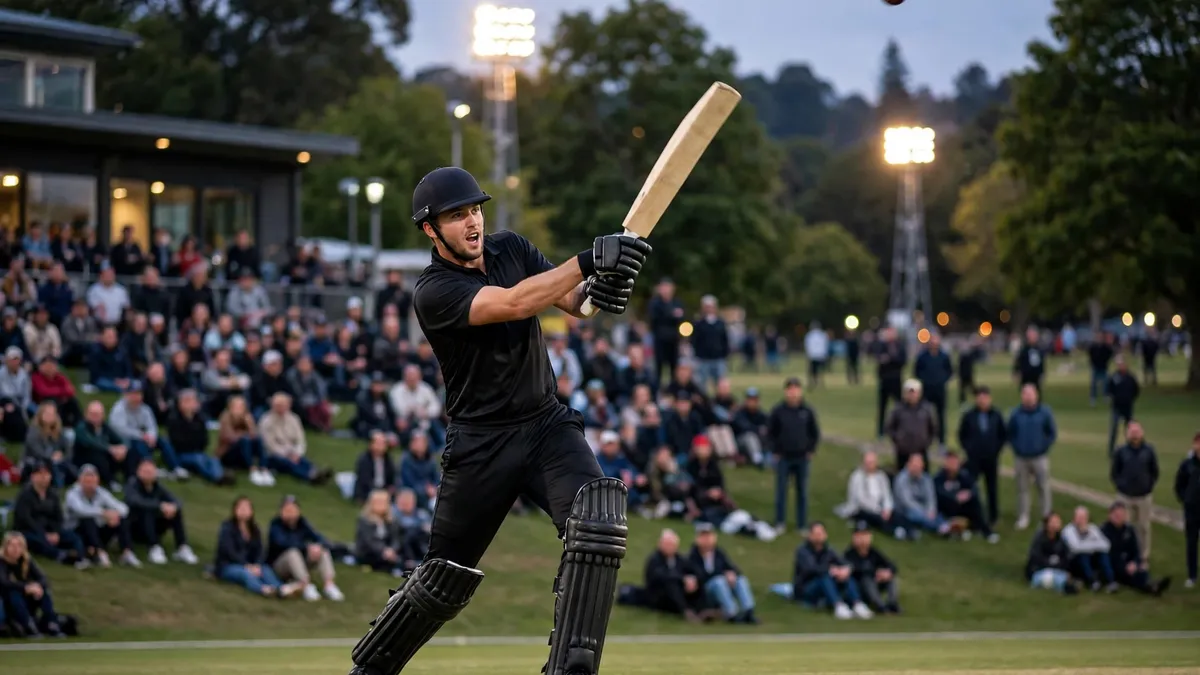
The Brendon McCullum fastest Test century farewell knock is the most extraordinary innings ever played in a final Test match. On 20 February 2016, at Hagley Oval in Christchurch, McCullum walked out to bat in his 101st and last Test with New Zealand in trouble at 74 for 4 against Australia. Seventy-nine balls later he was out for 145, having reached his hundred off just 54 balls, the fastest century in the 139-year history of Test cricket. He broke a record that had stood for 30 years, passed Adam Gilchrist’s record for the most sixes in Test cricket, and gave his home crowd a farewell they will never forget.
McCullum had announced his retirement on 22 December 2015, and the Christchurch Test was his goodbye. The third day of the match was the fifth anniversary of the 2011 Christchurch earthquake, which had claimed 185 lives and destroyed the city’s old Lancaster Park ground. Hagley Oval, the purpose-built ground that replaced it, was packed for the occasion, and McCullum gave the crowd the innings of his life.
Brendon McCullum Fastest Test Century Farewell: The 54-Ball Hundred
McCullum reached his fifty off 34 balls and his hundred off 54 balls, with 16 fours and four sixes at the time he raised his bat. The previous record for the fastest Test century was 56 balls, held jointly by Viv Richards, who made it against England at Antigua in 1986, and Misbah-ul-Haq, who matched it against Australia at Abu Dhabi in 2014. McCullum beat it by two balls, and he did it in his final Test, against the best bowling attack in the world.
He should not have been there to do it. On 39, he was caught by Mitchell Marsh off James Pattinson, only for the delivery to be ruled a no-ball. It was the reprieve that changed the match, and McCullum made Australia pay for it in the most brutal fashion imaginable. He finished on 145 off 79 balls, with 21 fours and six sixes, at a strike rate of 183.54, and he was eventually caught by Nathan Lyon off Pattinson.
The innings was built on a partnership. Corey Anderson made 72 off 66 balls, and the pair added 179 runs for the fifth wicket in just 110 balls, taking New Zealand from 74 for 4 to 253 for 5. BJ Watling added 58, and New Zealand closed on 370, a competitive total on a first day when they had been in deep trouble.
The Records McCullum Broke
The century itself was the headline, but the innings broke more than one record. The first of his six sixes took him past Adam Gilchrist’s record of 100 sixes in Test cricket. McCullum finished his career with 107 Test sixes, the most by any batsman in the history of the format, and a record that reflected the way he played the game: he attacked from the first ball, in every format, for his entire career.
He also became the first captain to score a hundred in his farewell Test, and his 170 runs in the match, 145 in the first innings and 25 in the second, were the most by a captain in a farewell Test. The innings was the perfect summary of his career: fearless, unorthodox and utterly committed to attack, even when the situation demanded caution.
The Match: Australia Win by Seven Wickets
For all the glory of McCullum’s innings, Australia won the match, and they won it comfortably. In reply to New Zealand’s 370, Australia made 505, with Joe Burns making 170 off 321 balls and Steven Smith 138 off 241. Adam Voges, unbeaten on 60 at one point, went past Don Bradman’s average of 99.94 during his innings before being dismissed for 60. Australia’s first-innings lead was 135 runs.
New Zealand’s second innings made 335, with Williamson and Anderson again among the runs, and McCullum making 25 off 27 balls in his final innings, caught by David Warner off Josh Hazlewood. Australia chased the target of 201 with seven wickets in hand, Burns finishing unbeaten, and won the series 2-0. Burns was named Player of the Match.
McCullum’s farewell was completed with a guard of honour from the Australian players as he walked out for his final innings, a mark of respect from opponents who had spent the day being dismantled by him. He bowled four overs in Australia’s first innings for three runs, a final reminder that he was, to the end, a cricketer who did everything at full pace.
Why the Brendon McCullum Fastest Test Century Farewell Still Matters
The 54-ball hundred still stands as the fastest century in Test cricket, and it is unlikely to be beaten soon. Test hundreds off fewer than 60 balls are rare, and they almost never come in a farewell match, against the top-ranked side, with a team in trouble at 74 for 4. The innings is also a measure of McCullum’s impact on the game: he captained New Zealand to their first World Cup final in 2015, transformed the side’s approach to Test cricket, and left the format with a record that may stand for decades.
For New Zealand, the Christchurch Test was the end of an era. McCullum’s retirement closed a chapter that had begun with his debut in 2004, and the side that Kane Williamson inherited was built on the aggressive, positive cricket McCullum had championed. The fastest Test century was his parting gift, and it was entirely in character: bold, fast and unforgettable. For more on the records that define the game, see our guide to the highest score by a wicketkeeper in the T20 World Cup and our list of the fastest players to score 1000 T20 runs.
| Brendon McCullum, 2nd Test vs Australia, Christchurch, 20 Feb 2016 | |
|---|---|
| Innings | 145 off 79 balls (21 fours, 6 sixes) |
| Century | 100 off 54 balls — fastest in Test history |
| Fifty | 50 off 34 balls |
| Previous record | 56 balls (Viv Richards 1986, Misbah-ul-Haq 2014) |
| Partnership | 179 runs with Corey Anderson (72) for the 5th wicket |
| Test sixes | 107 in his career, passing Gilchrist’s 100 |
| Match result | Australia won by 7 wickets; Australia won the series 2-0 |
| McCullum’s match | 145 and 25; his 101st and final Test |
Sources: cricinfo.com, archive.blackcaps.co.nz, m.cricbuzz.com.