
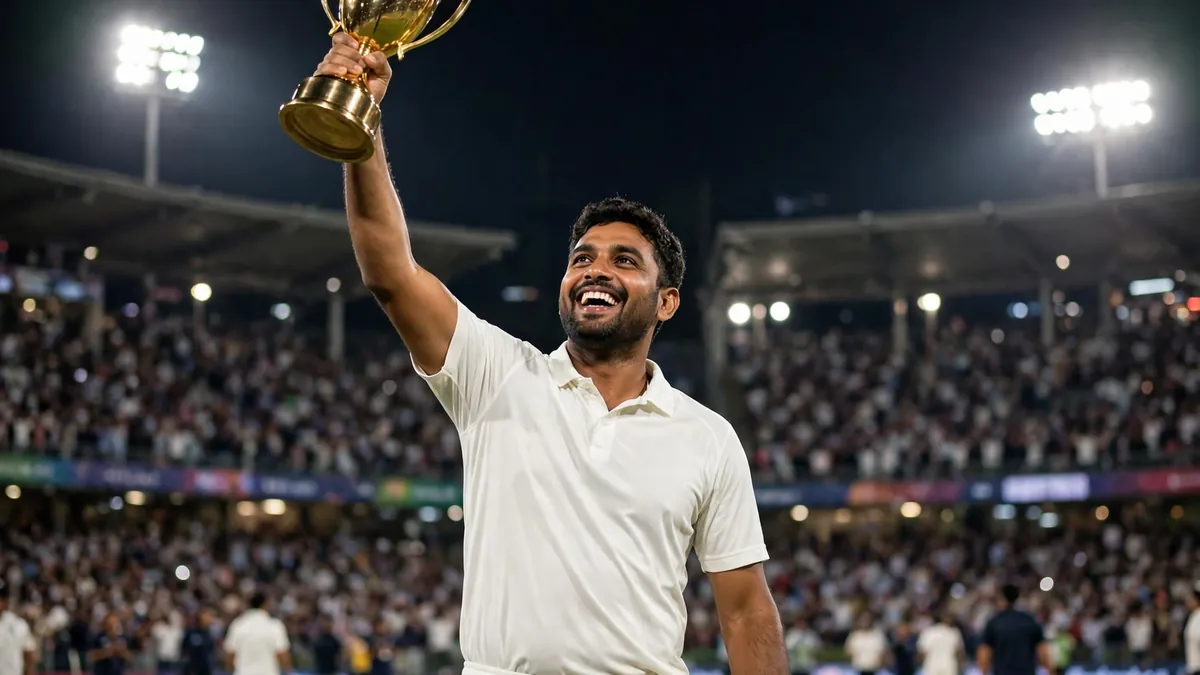
The T20 World Cup Player of the Tournament award has become one of the most telling honours in short-format cricket. It does not always go to a player from the winning team, and it does not always go to the highest run-scorer or the leading wicket-taker. It goes to the player who shaped the tournament most. This list covers every winner of the men's award, from the first edition in 2007 through to 2026. It is a men's-only list: the women's tournament has its own separate award history.
Across ten editions, only one man has won it twice. Three Indians have won it, and the 2026 winner arrived with one of the most dramatic turnarounds the award has ever seen. Here is the full story, winner by winner.
T20 World Cup Player of the Tournament Winners: The Full Table
| Edition | Winner | Team | Matches | Runs | Wickets | Champion |
|---|---|---|---|---|---|---|
| 2007 | Shahid Afridi | Pakistan | 7 | 91 | 12 | India |
| 2009 | Tillakaratne Dilshan | Sri Lanka | 7 | 317 | 0 | Pakistan |
| 2010 | Kevin Pietersen | England | 6 | 248 | 0 | England |
| 2012 | Shane Watson | Australia | 7 | 249 | 11 | West Indies |
| 2014 | Virat Kohli | India | 6 | 319 | 0 | Sri Lanka |
| 2016 | Virat Kohli | India | 5 | 273 | 1 | West Indies |
| 2021 | David Warner | Australia | 7 | 289 | 0 | Australia |
| 2022 | Sam Curran | England | 6 | 12 | 13 | England |
| 2024 | Jasprit Bumrah | India | 8 | 0 | 15 | India |
| 2026 | Sanju Samson | India | 5 | 321 | 0 | India |
2007: Shahid Afridi (Pakistan) — The All-Rounder Who Set the Standard
Shahid Afridi was the first-ever T20 World Cup Player of the Tournament, and he won it despite Pakistan losing the final to India by five runs in Johannesburg. Afridi scored 91 runs and took 12 wickets in seven matches, and his leg-spin was Pakistan's most reliable weapon throughout the inaugural tournament. The award set an early precedent: it rewarded impact across a whole campaign, not just a place in the winning side.
2009: Tillakaratne Dilshan (Sri Lanka) — The Scoop That Changed Opening Batting
Tillakaratne Dilshan scored 317 runs in seven matches at the 2009 tournament in England, the most by any batter that year, and carried Sri Lanka to the final. His invention at the top of the order — above all the scoop over the wicketkeeper's head, soon nicknamed the "Dilscoop" — forced bowlers to rethink where they could safely bowl in the first six overs. Pakistan won the final at Lord's, but Dilshan, with 317 runs at an average of 52.83, had already defined the tournament.
2010: Kevin Pietersen (England) — England's First World Title
Kevin Pietersen scored 248 runs in six matches as England won their first ICC world title in the Caribbean in 2010, beating Australia by seven wickets in the final in Barbados. Pietersen averaged 62.00 in the tournament, with a best of 73 not out, and his batting gave England's campaign its swagger. He was the tournament's second-highest run-scorer, and the award recognised that England's title was built on his batting as much as on their bowling.
2012: Shane Watson (Australia) — The Complete Tournament
Shane Watson's 2012 campaign in Sri Lanka remains one of the most complete all-round performances in T20 World Cup history. He scored 249 runs — the most in the tournament — and took 11 wickets, the second-most, in seven matches. Australia reached the semi-finals before losing to West Indies, the eventual champions, but Watson was the player every opposition team planned around. Few winners of this award have dominated both disciplines so evenly, and Watson's 2012 remains the benchmark for what an all-rounder can do across a whole T20 World Cup.
2014 and 2016: Virat Kohli (India) — The Only Two-Time Winner
Virat Kohli is the only player to have won the T20 World Cup Player of the Tournament award twice, and he did it in consecutive editions. In 2014 in Bangladesh he scored 319 runs in six matches at an average of 106.33 — the most runs in a single edition at that time — as India reached the final, where they lost to Sri Lanka. Two years later, on home soil, he scored 273 runs in five matches at an average of 136.50, dismissed only twice in the whole tournament. India lost a thrilling semi-final to West Indies in Mumbai, but Kohli's chases — calm, precise, almost mechanical under pressure — had already made him the player of the tournament. The back-to-back awards remain unique.
For more on Kohli's record-breaking tournament batting, see our list of centuries in the T20 World Cup.
2021: David Warner (Australia) — Written Off, Then Decisive
David Warner arrived at the 2021 tournament in the UAE short of form and short of supporters. He left it as a world champion and the T20 World Cup Player of the Tournament, with 289 runs in seven matches. Warner's 53 in the final against New Zealand set up Australia's eight-wicket win in Dubai, and his semi-final fifty against Pakistan had been just as important. Warner found his best form exactly when Australia needed it.
2022: Sam Curran (England) — The Death Bowler
Sam Curran won the award in 2022 with the ball, taking 13 wickets in six matches at an average of just 11.38. He was also Player of the Match in the final, taking 3 for 12 as England beat Pakistan by five wickets at the MCG. Curran's left-arm pace at the death — yorkers, slower balls, and a calm head in the final overs — made him England's most trusted bowler in a tournament where conditions in Australia rewarded skill over sheer pace. His 12 runs with the bat tell their own story: this was a bowling award, won by a bowler who decided matches in the last four overs.
2024: Jasprit Bumrah (India) — The Most Valuable Bowler in the Tournament
Jasprit Bumrah's 2024 campaign was one of the great bowling performances in T20 World Cup history. He took 15 wickets in eight matches at an average of 8.26 and an economy rate of 4.17 as India went unbeaten to the title, beating South Africa by seven runs in the final in Barbados. Bumrah's spell in that final — including the decisive 19th over — is already part of Indian cricket folklore, but the award recognised eight matches of control, not one over. Read our full look back at that unbeaten campaign in ICC Men's T20 World Cup 2024.
2026: Sanju Samson (India) — The Great Turnaround
Sanju Samson won the T20 World Cup Player of the Tournament award in 2026 after one of the most remarkable turnarounds in the award's history. He had not played a match in India's 2024 title-winning squad, and he entered the 2026 tournament after a run of low scores in the five-match T20I series against New Zealand. He played only five matches in the tournament — yet scored 321 runs at an average of 80.25 and a strike rate of 199.37, the third-most runs in a single edition, behind Sahibzada Farhan's 383 and Tim Seifert's 326 in the same tournament, and still ahead of Kohli's 319 from 2014.
Samson's defining innings came in the final itself: 89 off 46 balls as India posted 255 for 5 against New Zealand at the Narendra Modi Stadium in Ahmedabad, a total India defended to win by 96 runs and claim a third T20 World Cup title. It was his third successive fifty-plus score in the knockout phase. He became only the third Indian to win the award, after Kohli and Bumrah, and the first to win it after playing just five matches.
What the T20 World Cup Player of the Tournament List Tells Us
Look at the ten names together and a pattern emerges. The award has gone to five batters, two bowlers, two all-rounders in the broadest sense, and one player — Watson — who genuinely did both. It has gone to players from losing finalists (Afridi, Dilshan, Kohli twice) and to players from teams that did not even reach the final (Watson in 2012). That is what makes it worth following: it is a judge of individual tournaments, not a consolation prize for the champions.
It also tracks how the format itself has changed. Afridi won it with leg-spin and cameos; Dilshan won it by inventing shots; Bumrah won it by making scoring almost impossible; Samson won it by scoring at nearly two runs a ball. The skills change, but the test stays the same: who owned the tournament when it mattered most?
For the records these winners set along the way, see T20 World Cup Records 2007–2016: The Early Years.
Sources: icc-cricket.com, sportstar.thehindu.com, indianexpress.com, crictoday.com, icc-cricket.com.