
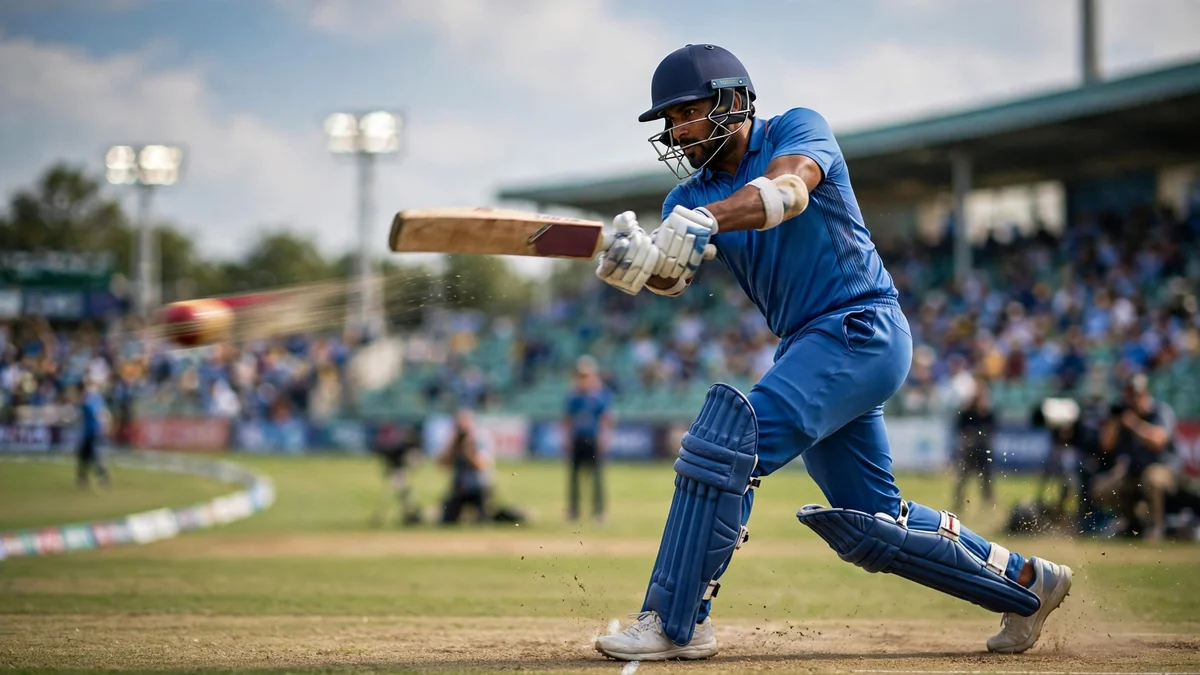
Sixteen balls: the record
The fastest fifty in ODI history took just 16 balls. AB de Villiers reached the mark for South Africa against West Indies at Johannesburg on 18 January 2015 — and in the same innings he went on to score the fastest ODI hundred in history, off 31 balls, finishing on 149 off 44 balls with nine fours and 16 sixes. For a decade, his 16-ball fifty stood alone. In 2025, West Indies’ Matthew Forde matched it, in a way nobody saw coming. These are the eight fastest fifties in ODI cricket.
The list
| Rank | Batter | Balls | Score | Opposition | Venue | Date |
|---|---|---|---|---|---|---|
| 1= | AB de Villiers (SA) | 16 | 149 off 44 | West Indies | Johannesburg | 18 Jan 2015 |
| 1= | Matthew Forde (WI) | 16 | 58 | Ireland | Dublin | 23 May 2025 |
| 3= | Sanath Jayasuriya (SL) | 17 | 76 | Pakistan | Singapore | 7 Apr 1996 |
| 3= | Kusal Perera (SL) | 17 | 68 | Pakistan | Pallekele | 15 Jul 2015 |
| 3= | Martin Guptill (NZ) | 17 | 93 | Sri Lanka | Christchurch | 28 Dec 2015 |
| 3= | Liam Livingstone (ENG) | 17 | 66* | Netherlands | Amstelveen | 17 Jun 2022 |
| 7= | Simon O’Donnell (AUS) | 18 | 74 | Sri Lanka | Sharjah | 2 May 1990 |
| 7= | Shahid Afridi (PAK) | 18 | 102 | Sri Lanka | Nairobi | 4 Oct 1996 |
De Villiers and the Fastest Fifty in ODI History
The Johannesburg innings of 18 January 2015 is the most destructive batting ever seen in a one-day international. De Villiers reached his fifty off 16 balls, his hundred off 31, and finished on 149 off 44 balls. The nine fours and 16 sixes he hit are still the record for sixes in an ODI innings. South Africa posted 439 for 2 — at the time the second-highest ODI total ever — and won by 148 runs. What makes it remarkable is that de Villiers did not slog: he hit the ball to all parts of the ground, using the full 360 degrees of the field, against a West Indies attack that included Jason Holder. It is the innings every power-hitter since has been measured against.
Forde: the surprise joint holder
For a decade, de Villiers’ record looked untouchable. Then, on 23 May 2025 in Dublin, Matthew Forde — a West Indian fast bowler better known for his seam bowling than his batting — reached fifty off 16 balls against Ireland, finishing on 58. It was a 14-ball improvement on his previous best and a reminder that in modern ODI cricket, the record can fall to anyone. Forde’s fifty was the first time in the history of the format that a batter outside the top order had reached fifty that quickly.
The 17-ball club
Four players share the 17-ball mark, and they span three decades. Sanath Jayasuriya’s 17-ball fifty against Pakistan at Singapore in April 1996 was the original: it made him the first player to reach fifty in 17 balls in ODI cricket, and it launched the revolution in opening batting that changed the format forever. Kusal Perera matched it against the same opposition in 2015, Martin Guptill did it against Sri Lanka in Christchurch the same year, and Liam Livingstone joined the club against the Netherlands at Amstelveen in 2022, in the match where England posted 498 — the highest ODI total in history.
The 18-ball pioneers
Simon O’Donnell’s 74 off 18 balls against Sri Lanka at Sharjah in 1990 was the fastest ODI fifty of the twentieth century — a record that stood for six years. Shahid Afridi’s 18-ball fifty against Sri Lanka at Nairobi in October 1996 came in the innings that made him famous: he went on to score 102 off 37 balls, the fastest ODI century in history at the time, at the age of 16. Afridi’s hundred record stood for 18 years until de Villiers broke it — in the same innings in which de Villiers set the fifty record.
The Indian record
The fastest fifty by an Indian in ODI cricket belongs to Ajit Agarkar, who reached the mark off 21 balls against Zimbabwe at Rajkot. India have produced the format’s greatest batters, but the 16-ball mark remains beyond them — for now.
Why the Fastest Fifty in ODI Cricket May Stand for a While
The fastest fifty in ODI history has stood at 16 balls since 2015, and only one man has matched it in a decade. To beat it, a batter must score 50 off 15 balls or fewer — and in a format where the new ball still swings and the field is up, that is an extraordinary ask. De Villiers did it once. Forde matched him. The next man to beat it will have to do something nobody has ever done.
Also read: Fastest Players to Score 1000 T20 Runs and 10 Batsmen With the Highest Strike Rate.
Sources: espncricinfo.com, espncricinfo.com, icc-cricket.com, icc-cricket.com, guinnessworldrecords.com, inningsbreak.com, inningsbreak.com.