
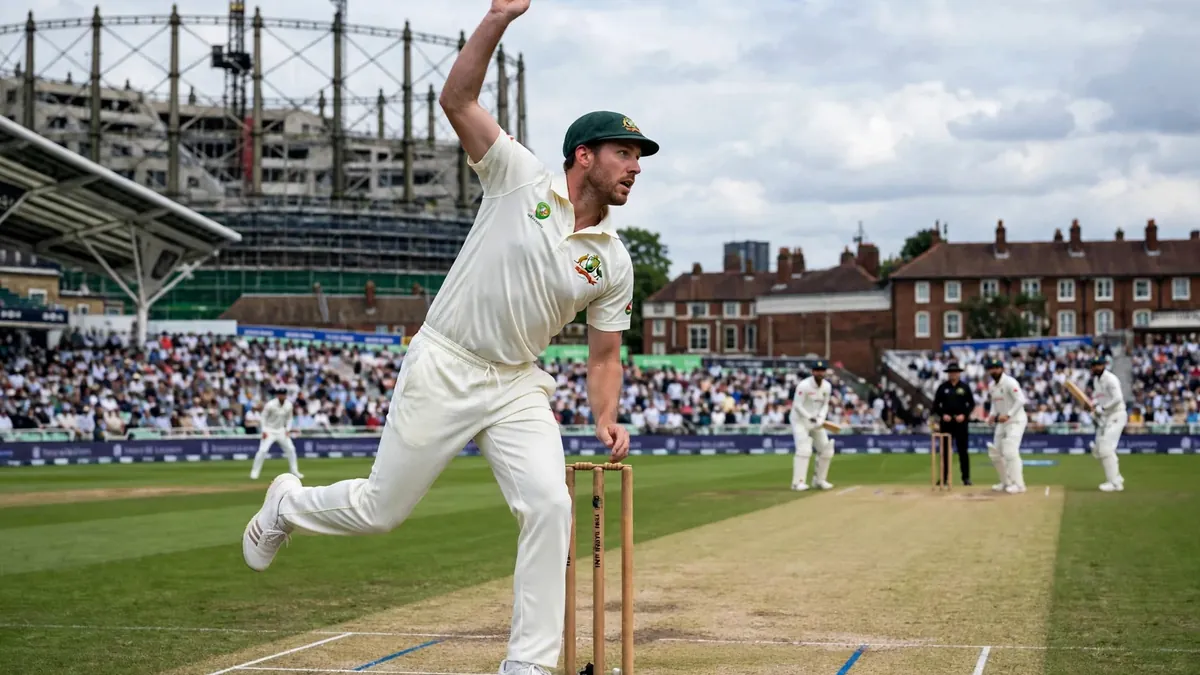
The World Test Championship Final 2023 was played at The Oval in London from 7 to 11 June 2023, and it was decided, in truth, on the first day. Australia, sent in to bat by India after Rohit Sharma won the toss, were 76 for 3 — and then Travis Head and Steve Smith added 285 runs together and took the match away. Australia won by 209 runs, becoming the second winners of the World Test Championship, and India lost a second straight final.
It was a final that asked a simple question of India and got a blunt answer: could they bat last against a complete Australian attack, chasing a record total, after conceding 469 in the first innings? They could not. Here is how the match unfolded, and what it meant for both teams.
World Test Championship Final 2023: The Match in Brief
| Australia | India | |
|---|---|---|
| 1st innings | 469 (121.3 overs) | 296 (69.4 overs) |
| 2nd innings | 270/8 declared (84.3 overs) | 234 (63.3 overs) |
| Result | Australia won by 209 runs | |
| Venue | The Oval, London, 7–11 June 2023 | |
| Player of the Match | Travis Head (163 and 18) |
Day One: Head and Smith Take the Final Away
India's decision to bowl first looked inspired for an hour. Mohammed Siraj removed Usman Khawaja for a duck, and when Marnus Labuschagne fell for 26 and David Warner for 43, Australia were 76 for 3 in the 24th over. Then Travis Head walked in and changed the match.
Head scored 163 off 174 balls, with 25 fours and a six, reaching his century before tea on the first day. Smith, at the other end, was his usual unhurried self: 121 off 268 balls, with 19 fours. Their 285-run partnership for the fourth wicket was the highest partnership of the match by a distance, and by the close of day one Australia were 327 for 3, with Head on 146 and Smith on 95. The Oval pitch was good for batting, but India had let the two men who most punish loose bowling settle — and neither gave them a second chance.
Australia were eventually bowled out for 469 in 121.3 overs. Siraj was India's best bowler with 4 for 108, Shardul Thakur took 2 for 83, Mohammed Shami 2 for 122, and Ravindra Jadeja 1 for 56. Alex Carey contributed 48. The total was imposing, but the damage was really the partnership: 285 runs in a final, after India had done the hard work of taking three early wickets.
India's First Innings: Rahane's Rescue, and a 173-Run Deficit
India's reply began badly and never fully recovered. Rohit Sharma fell for 15, Shubman Gill and Cheteshwar Pujara followed cheaply, and Virat Kohli made only 14 as India slipped to 71 for 4. Ajinkya Rahane, recalled to the Test side after more than a year away, and Ravindra Jadeja rebuilt with a stand of 71. Jadeja made 48 off 51 balls, and Rahane went on to 89 off 129 balls, with 11 fours and a six.
Shardul Thakur, batting at No. 8, added 51 off 109 balls and shared a 109-run stand with Rahane for the seventh wicket — the partnership that saved India from a far worse deficit. India were bowled out for 296 in 69.4 overs, conceding a first-innings lead of 173 runs. Pat Cummins took 3 for 83, Mitchell Starc and Scott Boland took two wickets each, Cameron Green took two, and Nathan Lyon took one. Rahane's 89 was the highest score of India's match, and it was also a personal statement: dropped, written off, recalled for a final, and India's best batter across both innings.
Australia's Second Innings: Carey Closes the Door
Australia did not need to be spectacular in their second innings; they needed to be safe, and then to declare with enough time to bowl India out. They were 270 for 8 declared in 84.3 overs. Marnus Labuschagne made 41 off 126 balls, Steve Smith 34, Cameron Green 25, and Alex Carey finished unbeaten on 66 off 105 balls, with eight fours. Mitchell Starc hit a quick 41 off 57 balls to push the lead past 400.
Jadeja was India's best bowler in the innings with 3 for 58, while Shami took 2 for 39 and Umesh Yadav 2 for 54. But the arithmetic was brutal: India needed 444 runs to win, in the fourth innings of a Test, against Cummins, Starc, Boland and Lyon. No team had ever chased that many to win a Test. The target was a record chase in every sense — and Australia had a day and a half to defend it.
The Chase: 164 for 3 Overnight, Then the Boland Over
India's second innings began with real hope. Rohit Sharma made 43 off 60 balls, Shubman Gill 18, and Cheteshwar Pujara 27, and by stumps on day four India were 164 for 3, with Kohli on 44 and Rahane on 20. The partnership between Kohli and Rahane had added 86 runs, and for the first time in the match an Indian fightback felt possible.
It lasted one over on the fifth morning. Scott Boland, who had been Australia's unsung hero all match, dismissed Kohli for 49 — caught by Smith at second slip off a wide ball Kohli chased — and then removed Jadeja for a duck two balls later, caught behind. India had slipped from 164 for 3 to 179 for 5 without adding a run of substance, and the match was effectively over.
Rahane made 46 off 108 balls before edging Starc behind, and the rest followed quickly. India lost their last seven wickets for 70 runs and were bowled out for 234 in 63.3 overs, before lunch on the fifth day. Nathan Lyon took 4 for 41, Boland finished with 3 for 46, Starc took 2 for 77, and Cummins 1 for 55. Mohammed Shami was unbeaten on 13. The margin — 209 runs — was the largest by runs in a World Test Championship final.
Travis Head: Player of the Match
Travis Head was named Player of the Match for his 163 in the first innings, and the award was never in doubt. His 18 in the second innings was a footnote; the first-innings hundred was the innings of the final. Head had come into the match after a strong two years in Test cricket, and he batted like a man who believed the final was his stage. He scored at nearly a run a ball against an attack that included Siraj, Shami and Jadeja, and he did it after Australia had lost three early wickets. Smith's 121 was the anchor; Head's 163 was the statement.
India's Second Straight WTC Final Loss
This was India's second defeat in a World Test Championship final. In the inaugural final at Southampton in June 2021, New Zealand beat India by eight wickets, chasing 139 on the reserve day after rain had washed out two days' play. India had scored 217 and 170 in that match, with New Zealand replying with 249 and 140 for 2, and Kyle Jamieson was Player of the Match with 5 for 31 in the first innings.
The two defeats were different in character but similar in meaning. In 2021 India lost a low-scoring match in difficult conditions to a superb seam attack. In 2023 they were outplayed in every department by a team that had topped the 2021–23 points table: out-batted in the first innings, out-bowled with the old ball and the new, and unable to sustain a chase. India had reached both finals — a genuine achievement across two long cycles — but had no trophy to show for it, and the wait for a first global title in a decade went on. Rohit Sharma said afterwards that India had not applied themselves with the bat in the second innings. It was hard to argue.
What the World Test Championship Final 2023 Meant for Australia
For Australia, the win completed the set. They became the first men's team to win every major ICC trophy — the 50-over World Cup, the T20 World Cup, the Champions Trophy and now the World Test Championship — and their ninth ICC title overall. It was also a personal vindication for Pat Cummins, captaining in his first ICC final, and for a team that had missed the inaugural final two years earlier after being penalised points for a slow over-rate.
The victory also set up their summer: the Ashes began five days later, and Australia carried the Mace into that series as world Test champions. Head's hundred, Smith's hundred, Carey's unbeaten 66, Lyon's four wickets and Boland's decisive over were all pieces of the same picture — a team with no weak link, winning a final the way champions do: by taking the match away early and never letting it back.
For more on the tournaments that built these two teams, see ICC Men's T20 World Cup 2024 and our list of centuries in the T20 World Cup.
Sources: cricinfo.com, cricbuzz.com, cricket.com.au, cricinfo.com.