
The T20 World Cup 2024 format was the biggest change the tournament had seen since it began in 2007. For the first time, 20 teams took part instead of 16, the event was co-hosted by two regions — the West Indies and the United States — and the old Super 12 stage was replaced by a group stage followed by Super 8s. The result was a longer, wider tournament: 55 matches played from 1 to 29 June 2024 across nine venues.
This guide explains exactly how that format worked, who the new teams were, what rules decided tied and rain-affected games, and how the structure shaped the outcome — India lifting the trophy in Barbados. For what happened on the field, see our ICC T20 World Cup 2024 recap, and for the previous edition, our ICC Men's T20 World Cup 2022 guide.
T20 World Cup 2024 Format: The Big Picture
The 2024 tournament was the ninth edition of the ICC Men's T20 World Cup, announced in November 2021 for the West Indies and the United States. It was the first major ICC tournament to include matches played in the United States, while the West Indies had previously hosted the competition in 2010.
The expansion from 16 to 20 teams was the headline change. The 20 places went to the two hosts, the top eight teams from 2022, the two highest-ranked teams in the ICC Men's T20I rankings not already qualified, and eight teams from regional qualifiers. The tournament was split into three stages:
| Stage | Teams | Matches |
|---|---|---|
| Group stage | 20 teams in 4 groups of 5 | 40 |
| Super 8s | 8 teams in 2 groups of 4 | 12 |
| Knockouts | 2 semi-finals + final | 3 |
| Total | 55 |
That structure mattered for the smaller teams. In the old 16-team format, four teams had to survive a first round just to reach the main event. In 2024 there was no first round: every team started in the group stage and was guaranteed four matches.
T20 World Cup 2024 Format: The Group Stage
The 20 teams were divided into four groups of five. Each team played the other four teams in its group once, in a single round-robin, and the top two teams from each group advanced to the Super 8s. The other 12 teams were eliminated. The group stage ran from 1 to 17 June 2024.
The groups were:
- Group A: India, Pakistan, Ireland, Canada, USA
- Group B: England, Australia, Namibia, Scotland, Oman
- Group C: New Zealand, West Indies, Afghanistan, Uganda, Papua New Guinea
- Group D: South Africa, Sri Lanka, Bangladesh, Netherlands, Nepal
The group stage was played across all nine venues — six in the West Indies and three in the United States. The American venues were Grand Prairie Cricket Stadium in Dallas, Nassau County International Cricket Stadium in New York, and Broward County Stadium in Lauderhill, Florida. The tournament opened in Dallas on 1 June, when co-hosts USA beat Canada by seven wickets.
One quirk deserves attention. Before the tournament, the ICC named eight seeded teams for the Super 8 stage based on their T20I rankings. Once a team advanced, it was placed in a predetermined Super 8 slot, regardless of whether it finished first or second in its group — so group position mattered less than simply qualifying.
The Super 8s: Eight Teams, Two Groups
The eight group-stage qualifiers were split into two Super 8 groups of four. Each team played the other three teams in its group once, and the top two from each group advanced to the semi-finals. The Super 8 stage ran from 19 to 24 June 2024, and every Super 8 match — like all of the knockout games — was played in the Caribbean.
The Super 8 groups, as determined by the seedings, were:
- Super 8 Group 1: India, Australia, Afghanistan, Bangladesh
- Super 8 Group 2: South Africa, England, West Indies, USA
India won all three of their Super 8 games to top Group 1, with Afghanistan second — a result that sent Afghanistan to their first ever World Cup semi-final and eliminated Australia, the 2021 champions. In Group 2, South Africa also won all three games, with defending champions England second. Both co-hosts went out at this stage: the West Indies won one of three, and the USA lost all three.
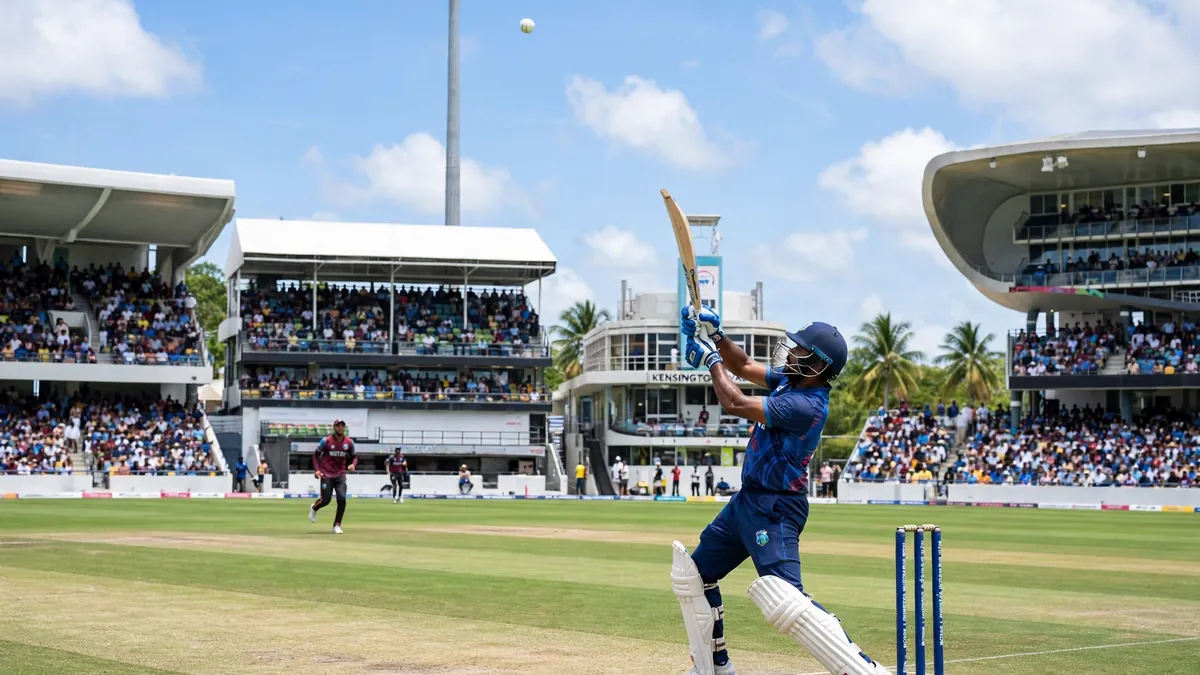
The semi-final pairings followed a simple rule: the winner of each Super 8 group faced the runner-up of the other group. So India met England, and South Africa met Afghanistan. The semi-finals were played on 26 and 27 June 2024, in Guyana and Trinidad and Tobago, and the final was held at Kensington Oval in Barbados on 29 June 2024, with 30 June as the reserve day.
The New Teams: USA, Canada and Uganda
The expansion to 20 teams brought three debutants to the Men's T20 World Cup: the United States, Canada and Uganda all played in the tournament for the first time. The USA qualified automatically as co-hosts, while Canada and Uganda came through the regional qualifiers.
The debutants did far more than make up the numbers. The USA produced the shock of the group stage, beating Pakistan in a Super Over in Dallas on 6 June after both teams made 159. The Americans went on to finish second in Group A — ahead of Pakistan — and reach the Super 8s in their first ever World Cup. Canada beat Ireland by 12 runs in New York for their first win at the tournament. Uganda also won their first ever World Cup match, beating Papua New Guinea by three wickets in Guyana.
For the USA in particular, it was a breakthrough moment for cricket in the country. Sixteen of the 55 matches were played in the United States, with New York hosting eight of them, including the marquee India–Pakistan group game.
T20 World Cup 2024 Format: The Rules That Decided Games
Beyond the structure, several playing rules shaped how the 2024 tournament unfolded. The most important ones for readers to understand are the tie-breakers, the rain rules and the stop-clock.
Tied matches and Super Overs. If a match ended level, it was decided by a Super Over: each team faced six balls, and the higher-scoring team won. If the Super Over itself was tied, further Super Overs were played until there was a winner. The rule mattered immediately — the USA's win over Pakistan was decided in a Super Over, and Namibia also beat Oman in a Super Over in Barbados.
Rain and minimum overs. In the group stage and Super 8s, a minimum of five overs per side had to be bowled to constitute a result, with the Duckworth-Lewis-Stern (DLS) method used to decide rain-shortened games. In the semi-finals and final, that minimum rose to 10 overs per side. If no result was possible in a group or Super 8 game, the points were shared.
Reserve days — with one exception. The first semi-final and the final had reserve days. The second semi-final did not, because there was only one day between it and the final; instead, it had 250 minutes of extra time available on the scheduled day. The final's reserve day was 30 June. If a semi-final could not be completed, the team that finished higher in the Super 8 stage would have progressed; if the final could not be completed, the two teams would have been declared joint winners.
The stop-clock. The 2024 tournament was the first to use the stop-clock as a permanent part of white-ball cricket: the fielding side had to be ready to start each over within 60 seconds of the previous over ending. Trials had shown it saved around 20 minutes per ODI match, and it became mandatory in all full-member ODI and T20I matches from 1 June 2024.
The basics. Each team batted for a maximum of 20 overs, with a six-over powerplay at the start of each innings and two unsuccessful reviews allowed per innings.
Why This Format Worked — and What It Changed
The 2024 format did what the ICC hoped it would do. More teams meant more stories: a debutant reaching the Super 8s, Afghanistan reaching a first semi-final, and the United States hosting World Cup cricket for the first time. The group stage gave every team four games, so an early upset did not end a campaign the way it could in the old first-round format.
There were trade-offs: with 20 teams and only eight Super 8 places, the group stage still eliminated 12 teams quickly. But as a spectacle and as a way of growing the game, the format delivered: 55 matches, nine venues, three debutants, and a final that went to the last over.
The structure also set the template for the future: the T20 World Cup 2024 format was not a one-off experiment, but the shape of the modern Men's T20 World Cup. To see how it played out match by match, our ICC T20 World Cup 2024 recap covers the results and records in full.
Sources: en.wikipedia.org, icc-cricket.com, windiescricket.com, aljazeera.com, thecricketer.com, sportstar.thehindu.com, indiatvnews.com, sportsmole.co.uk, cricinfo.com.