

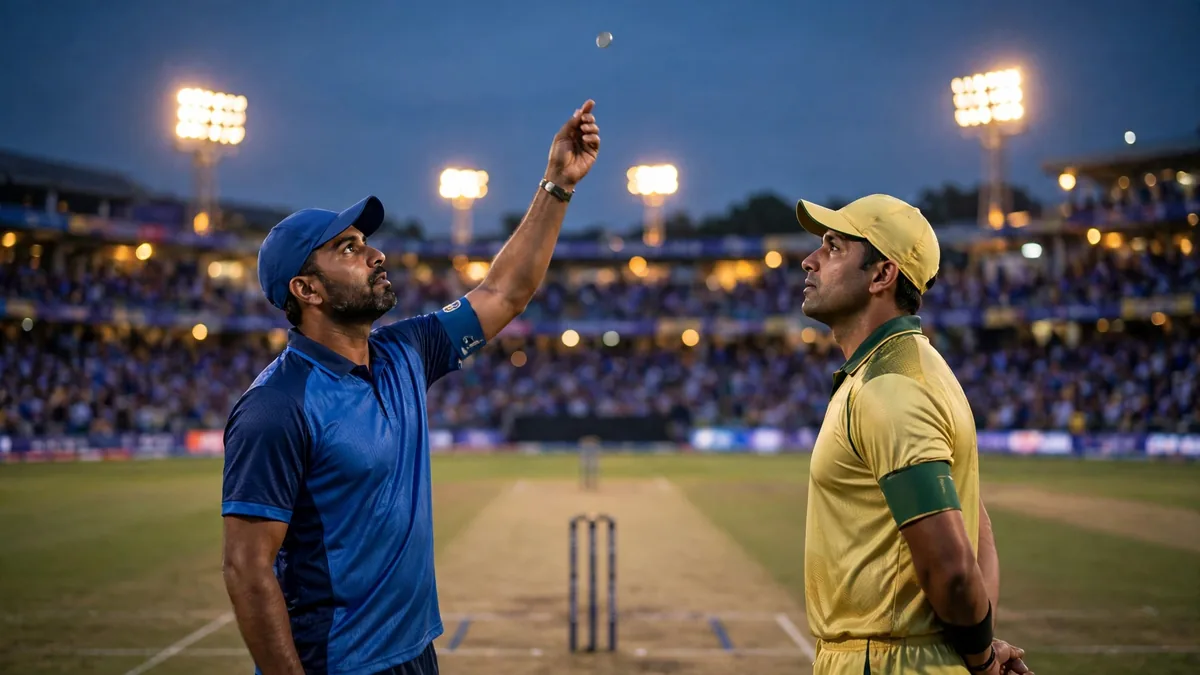
Before every big T20 match, thousands of fans search for a T20 toss prediction: who will win the toss, and what will the captain do with it? The toss feels like it should matter. Two captains, one coin, and a decision that shapes the whole evening.
Here is the honest answer up front: nobody can predict the toss, and winning it barely helps. The coin is a coin. But the decision that follows it — bat or bowl — does matter, and the data behind that decision is genuinely interesting. This article breaks down what the numbers actually say, so you can read a toss like an analyst instead of guessing like a fortune teller.
How the Toss Actually Works
About half an hour before the scheduled start, the two captains and the match referee walk to the middle. One captain calls heads or tails while the coin is in the air. The winner of that 50/50 call gets to choose whether their team bats or bowls first.
That is the whole event. There is no skill in it, no form guide, no pattern to spot. A captain who has “won the last five tosses” is exactly as likely to win the next one as a captain who has lost five in a row. Any website that claims to predict toss outcomes is selling you a story, not a method.
What captains can control is the decision. And in modern T20 cricket, that decision has become almost automatic: bowl first.
What the Numbers Say: Winning the Toss Barely Helps
The largest studies of toss data all reach the same conclusion — the advantage of winning the toss is tiny.
A peer-reviewed study by Sacheti, Gregory-Smith and Paton, published in the Journal of Sports Economics in 2016, analysed the full population of T20 Internationals played up to that point. It found that the team winning the toss won about 52% of matches — barely above a coin flip. Teams that chose to bat first won just under 52% of the time, and teams that chose to bowl first won slightly more than 51%. In day/night games, the picture was even stranger: toss winners won only 44% of matches.
An ESPNcricinfo analysis of more than 44,000 matches across Tests, ODIs, List A and T20 cricket reached a similar verdict. Across all formats combined, winning the toss added roughly a 2.8% higher chance of winning. In T20 cricket specifically, the advantage was even smaller — around 1.3%.
More recent data tells the same story. An analysis of Cricsheet ball-by-ball records covering 359 IPL matches from 2022 to 2026 found that toss winners went on to win 50.6% of decided matches. Across 1,462 T20 Internationals from the same period, toss winners won 49.9% — less than half. And a verified-results database covering the last 12 months of T20 cricket (2,362 results) puts the toss winner’s win rate at 52%.
| Source | Matches | Toss winner won |
|---|---|---|
| Sacheti et al., Journal of Sports Economics (2016) | Full T20I population to 2016 | ~52% |
| ESPNcricinfo (44,000+ matches, all formats) | 44,000+ | ~51–53% (T20 edge ~1.3%) |
| Cricsheet — IPL 2022–2026 | 359 | 50.6% |
| Cricsheet — T20Is 2022–2026 | 1,462 | 49.9% |
| FairPlay verified results (last 12 months) | 2,362 | 52% |
The pattern is unmistakable. Across every dataset, winning the toss is worth almost nothing on its own. The toss does not decide matches. Teams do.
Why Captains Almost Always Bowl First Now
If the toss barely matters, why do captains care so much about it? Because the decision matters more than the call — and the decision in modern T20 is nearly always the same: chase.
In the IPL from 2022 to 2026, toss winners chose to field first in 77.7% of matches, and that share has climbed every season — reaching 83.1% in the 2026 season. Across recent T20 cricket overall, toss winners chose to bowl first in about two-thirds of matches.
There are two good reasons for this. First, dew. In night games, especially in the subcontinent, dew settles on the outfield in the second innings. The ball gets wet, bowlers — above all spinners — struggle to grip it, and batting becomes easier. Second, the chase itself. Batting second means batting with a target on the board. The chasing team knows exactly what it needs, can plan every over against a fixed number, and never has to guess what a good score is.
The numbers back the choice up, modestly. In the IPL from 2022 to 2026, chasing teams won 52.5% of decided matches. In the FairPlay dataset, teams that chose to bowl first won 54% of the time, against 49% for teams that chose to bat. Chasing is a small edge, not a guarantee — but in a format of fine margins, captains take every small edge they can get.
When the Toss DOES Matter: Dew-Heavy Venues
The global average hides the real story, which is venue-specific. At most grounds the toss is noise. At a handful of grounds, it genuinely swings matches.
The classic example is Mumbai’s Wankhede Stadium. Evening dew there makes the ball wet and hard to grip in the second innings, especially for spinners. According to ESPNcricinfo’s analysis, teams that won the toss and chose to chase at the Wankhede won close to 57% of matches played there between 2008 and 2024 — far above the format’s usual average.
Dubai told a similar story at the 2021 T20 World Cup. All nine night matches at the Dubai International Stadium were won by the chasing team. That is why the final’s toss felt so important: Australia won it, inserted New Zealand, and chased down 173 with seven balls to spare to win their first T20 World Cup title by eight wickets.
The lesson is not that the toss wins matches. It is that conditions win matches, and the toss only matters when conditions change sharply between innings. A dry day game on a flat pitch? The toss is irrelevant. A humid night game at a dew-heavy ground? The toss can be worth a few percentage points — and captains know it.
Famous Toss Calls That Shaped Finals
2021 T20 World Cup final, Dubai — Australia won the toss, fielded, won by 8 wickets. Aaron Finch called correctly on a ground where every night game had been won by the chasing side. New Zealand posted 172/4, and Australia chased it down in 18.5 overs, with Mitchell Marsh unbeaten on 77.
2021 semi-final, Dubai — Australia won the toss, fielded, beat Pakistan by 5 wickets. Pakistan had posted 176/4, but Australia chased it with an over to spare. Both Australian knockout wins in that tournament came after winning the toss and chasing.
2024 T20 World Cup final, Barbados — India won the toss, batted, won by 7 runs. This one breaks the pattern, and that is the point. The final at Kensington Oval was a day game, so there was no dew to help the chasers. Rohit Sharma chose to bat first on a dry pitch, India posted 176/7, and South Africa fell seven runs short. Notably, the toss decided nothing about the tournament: India won three of their seven tosses and won all seven matches — three out of three after winning the toss, and four out of four after losing it. South Africa likewise won all eight of their games, winning the toss in only three of them.
So How Do You Make a T20 Toss Prediction?
You don’t. Nobody does. But you can read the situation around the toss — and that is what smart fans actually do. Before the coin goes up, check five things:
- Day or day/night? Dew only matters after sunset. In a day game, the toss is close to meaningless.
- The venue’s history. Some grounds heavily favour chasing; others don’t. Look at recent results at that ground, not the tournament as a whole.
- The weather. Humidity and dew forecasts matter more than any “toss prediction” you will find online.
- The pitch. A dry, used surface may turn later and favour the team batting first; a fresh, flat track usually favours the chasers.
- The teams. A side with a deep batting line-up and strong death bowlers will often prefer to chase; a side with a world-class spin attack may prefer to defend a total.
If a captain wins the toss at a dew-heavy venue in a night game, expect them to bowl first — and expect that choice to be worth a few percent. Anywhere else, the toss is theatre, and the cricket decides.
The Bottom Line
The search for a “best T20 toss prediction” ends in the same place every serious study does: the toss is a 50/50 coin flip, and winning it adds only about one or two percent to a team’s chance of winning a T20 match. No method, no pattern and no prediction can change that.
What the data does reward is attention to the things around the toss — dew, venue history, day versus night, and the captain’s decision. In T20 cricket, the call is luck. The choice is judgement. And judgement, unlike luck, can be studied.
This article is cricket analysis, not betting advice. No prediction method can beat a coin toss.