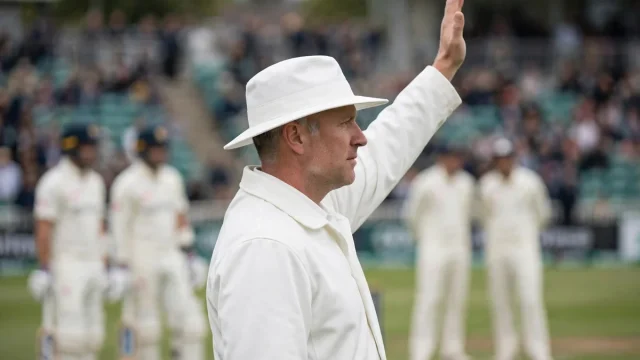


Fake fielding is one of cricket's strangest offences: a fielder is penalised not for what he does with the ball, but for pretending to have it. A dive, a shaped throw, a shout — if a fielder deliberately tries to fool the batters into thinking he has the ball when he does not, the umpires can award five penalty runs to the batting side. This guide explains the fake fielding cricket rules in full: what the law says, what happens when it is broken, and the real matches where it has been applied.
Fake fielding cricket rules: what MCC Law 41.5 says
Fake fielding is covered by Law 41.5 of the MCC Laws of Cricket, titled "Deliberate distraction, deception or obstruction of batter". The key clause, Law 41.5.1, states that it is unfair for any fielder wilfully to attempt, by word or action, to distract, deceive or obstruct either batter after the striker has received the ball.
In plain terms, the classic fake fielding offence is a fielder pretending to field or throw a ball he does not have — for example, diving to stop a shot, missing it, and then shaping to throw anyway so the batters hesitate and give up a run. The law also covers a wicketkeeper deliberately making it look as though he has missed the ball when he is holding it, in an attempt to lure a batter out of his ground for a stumping. The MCC's Laws manager has confirmed that such a trick would fall foul of Law 41.5.
Two points matter. First, the deception must be wilful: Law 41.5.2 leaves it to either umpire to decide whether the distraction, deception or obstruction was deliberate. An honest mistake, a slip, or a fielder simply shaping up to a ball he believes he can reach is not an offence. Second, the law sits alongside Law 41.4, which covers a fielder deliberately trying to distract or obstruct the striker while the striker is preparing to receive or receiving a delivery — the two laws together cover deception both before and after the ball is played.
Fake fielding cricket rules: the five-run penalty and the procedure
When an umpire decides a fielder has committed a fake fielding offence, the procedure under Law 41.5 is fixed:
1. Dead ball. The umpire immediately calls and signals dead ball and tells the other umpire the reason. 2. No dismissal. Neither batter can be dismissed from that delivery. 3. Five penalty runs. The bowler's end umpire awards five penalty runs to the batting side and informs the captains of both sides of the reason. 4. The ball does not count. The delivery does not count as one of the over. 5. Runs already completed stand. Any runs the batters completed before the offence are scored, along with the penalty runs. 6. The batters choose the strike. The two batters at the wicket decide which of them will face the next delivery. 7. A report is filed. The umpires together report the occurrence after the match to the executive of the offending side and to the relevant governing body.
If the obstruction involves physical contact, the umpires must also consider whether an offence under Law 42, which covers players' conduct, has been committed, and apply those procedures as well.
The five-run penalty is what makes the law bite. In a close limited-overs match, five runs awarded without a ball being bowled can decide the result — which is exactly why the law exists. Before it was introduced, fielders could fake a throw with no consequence beyond the umpire's disapproval, and batters who were fooled simply lost a run.
Fake fielding cricket rules: history of the law
Fake fielding was outlawed in the 2017 rewrite of the MCC Laws of Cricket, which the ICC adopted for international cricket in late September 2017. The MCC introduced the law because fielders were deliberately pretending to have the ball as a way of stopping batters from taking further runs, and there was no specific penalty for it.
The law was broken within a day of coming into force. On 29 September 2017, in a JLT One-Day Cup match between Queensland and a Cricket Australia XI at Allan Border Field in Brisbane, Queensland fielder Marnus Labuschagne dived in the covers to stop a shot from Param Uppal, missed the ball completely, and then shaped to throw anyway. Uppal hesitated, then completed the run once he realised Labuschagne had not fielded the ball — but the umpires had already spotted the deception and awarded five penalty runs to the Cricket Australia XI, who went on to post 279 for 7. Labuschagne, who apologised to the umpire at once, became the first player ever penalised under the new law. Queensland still won the match by four wickets, with Labuschagne making 61 off 62 balls in the chase, but his place in the law books was secure.
Fake fielding cricket rules: famous incidents where no penalty was given
The law has rarely been applied at the highest level, which is part of what makes it so debated. The most famous case came in the 2022 T20 World Cup, when Bangladesh wicketkeeper Nurul Hasan accused Virat Kohli of fake fielding during India's match against Bangladesh in Adelaide on 2 November 2022. In the seventh over of Bangladesh's chase, Kohli feigned as if he were relaying an Arshdeep Singh throw from the deep. Neither the umpires, Marais Erasmus and Chris Brown, nor the two batters in the middle spotted it, and no penalty was awarded. India won the match by five runs under the DLS method — exactly the margin of the penalty that would have applied had the umpires judged Kohli's action to be deliberate deception. The incident remains an accusation, not a proven offence, and it shows how much of the law rests on the umpires seeing the act and judging it wilful in real time.
A similar episode came during the 2019 Ashes, when England wicketkeeper Jonny Bairstow was accused of fake fielding to put pressure on Australia's Steve Smith. Again, no penalty runs were awarded. Both cases underline the same point: the law is only as strong as the umpires' view of the incident, and in a fast-moving game, a feigned throw can easily pass unnoticed.
Fake fielding cricket rules: what is not fake fielding
Not every dummy or decoy on a cricket field is an offence. A fielder who genuinely chases a ball, a fielder who shapes to throw a ball he actually holds, and a fielder who moves to back up a throw are all playing the game normally. The law targets only a wilful attempt to deceive — a fielder acting as though he has the ball when he knows he does not, or using words or gestures to distract a batter after the ball has been played.
That judgement call is the heart of the law. Umpires must decide, in the moment, whether a fielder was trying to trick the batters or simply doing his job with enthusiasm. It is a difficult call, and it is why the law is applied so rarely — but when it is applied, as Labuschagne discovered in Brisbane in 2017, the five-run penalty is immediate and there is no appeal.
For more on how the laws shape the modern game, see our guide to the best cricket player in the world and the greatest matches of the men's 2022 T20 World Cup, where the Kohli fake fielding debate took place.
Sources: lawsofcricket.lords.org, espn.ph, sportstar.thehindu.com, business-standard.com, Www.cricbuzz.com.